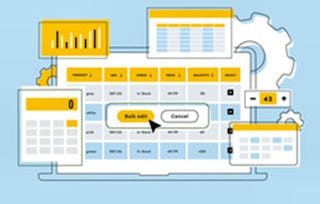
Data Entry: Capture and Upload Fast is a hands-on, beginner-level course for any professional tasked with entering and managing data in enterprise systems. Inefficient, manual data entry is a direct path to costly errors and operational delays. This course equips you with the two core skills needed to work faster and smarter: keyboard-driven navigation and bulk-data uploading.
First, you will move beyond the mouse by memorizing and applying key keyboard shortcuts and internalizing field-validation rules to prevent errors before they happen. Next, you will learn how to transition from single-record entry to high-volume efficiency by using a CSV template to upload an entire product catalogue in a single, verified operation. Through system navigation quizzes and hands-on upload exercises, you will build the speed and accuracy required to become a trusted data steward in your organization.
This module is about breaking the reliance on the mouse and building true efficiency. You will learn why keyboard shortcuts are the key to speed and how field-validation rules are your first line of defense against errors. We will cover what specific shortcuts (such as Ctrl+F4 and F2) do and the principles of data integrity. You will learn how to apply them in a simulated environment, apply your knowledge in a hands-on quiz, and assess your newfound speed.
涵盖的内容
2个视频2篇阅读材料1个作业
显示有关单元内容的信息
2个视频•总计11分钟
Why Your Mouse is Slowing You Down?•5分钟
How To Navigate and Edit with Keyboard Commands?•6分钟
2篇阅读材料•总计19分钟
Essential Shortcuts: Mastering F2 and Ctrl+F4•10分钟
The Rules of the Field: Understanding Data Validation•9分钟
1个作业•总计15分钟
Knowledge check: System Navigation Challenge•15分钟
Mastering Bulk Uploads
第 2 单元•小时 后完成
单元详情
This module focuses on scaling your data entry skills from handling one record to multiple records. You will learn why bulk uploads are essential for efficiency in procurement and catalogue management. We will provide a CSV template (what) and show you how to populate it correctly and use the system's upload tool. You will apply these skills by preparing and validating a file before being assessed in a final project where you execute a complete bulk upload.
涵盖的内容
2个视频1篇阅读材料2个作业
显示有关单元内容的信息
2个视频•总计12分钟
Why Enter One When You Can Enter Thousands?•6分钟
How-To: Prepare and Execute a CSV Upload•7分钟
1篇阅读材料•总计10分钟
Anatomy of a Bulk-Upload Template•10分钟
2个作业•总计50分钟
Final project: Data Entry and System Navigation Toolkit•20分钟
Coursera brings together a diverse network of subject matter experts who have demonstrated their expertise through professional industry experience or strong academic backgrounds. These instructors design and teach courses that make practical, career-relevant skills accessible to learners worldwide.
What does fast, accurate data entry mean in this course?
In this course, fast, accurate data entry means handling information in software applications with a keyboard-first, validation-aware approach instead of relying on repetitive clicking. The emphasis is on capturing single records cleanly and knowing when to shift to bulk upload for higher-volume work.
When would you use this approach to data entry?
You would use this approach whenever you need to enter, correct, or load data into a system and small mistakes could create downstream issues. The course especially frames it for recurring record updates and situations where a larger set of items is better handled as a structured upload.
How does this data entry approach fit into a broader workflow?
It sits at the point where information first enters the system, supporting both day-to-day record maintenance and larger catalogue updates. In the course, it connects careful field-level entry with the later step of preparing validated files for bulk import.
How is this way of working different from manual one-by-one data entry?
Manual one-by-one entry depends on repeated mouse clicks and retyping, while this way of working uses keyboard navigation, validation checks, and bulk upload when volume increases. The difference is that the course teaches a more structured way to enter data consistently across both single-record and multi-record tasks.
Do you need any prerequisites before learning this data entry approach?
No deep technical background is required, but it helps to be comfortable typing in business software and working with basic spreadsheet files. Because the course is beginner level, the focus is on following required formats, using shortcuts, and checking data carefully rather than on advanced system knowledge.
What tools, platforms, or methods are used in this course?
The course uses a software application for data entry and import tasks, along with spreadsheet-based CSV files for bulk uploads. The main methods are keyboard shortcuts, field-validation rules, and a structured upload template.
What specific tasks will you practice or complete in this course?
You practice keyboard-based navigation and editing, applying field-validation checks during entry, preparing structured CSV files, and uploading batches of records into the system. Together, those tasks show how to move from single-record work to a more repeatable bulk-entry process.