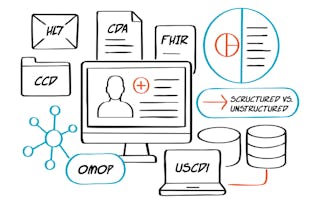
Explores issues of data representation in healthcare systems, including patient and provider identification, audit trails, authentication, and reconciliation. Discusses the underlying design of repositories for electronic health records (EHRs) and computerized provider order entry (CPOE) systems. Includes an overview of privacy issues, legislation, regulations, and accreditation standards unique to healthcare.
Welcome to Data Management in Healthcare! Before we can understand healthcare information systems, we need to understand the environment they operate in — and the data those systems are built to manage.
Healthcare generates enormous amounts of data: clinical, financial, regulatory, and operational. But healthcare data isn't like data in other industries. Errors don't just cause inconvenience — they can harm or kill patients. Fragmentation isn't just inefficient — it's a structural feature of how the U.S. system is organized. And governance isn't optional — it's a regulatory and safety imperative.
In this module, you'll explore what makes healthcare data unique, how data flows across the ecosystem, and what it takes to manage that data well.
涵盖的内容
1个视频9篇阅读材料1个作业1个应用程序项目
显示有关单元内容的信息
1个视频•总计1分钟
Meet Your Faculty•1分钟
9篇阅读材料•总计117分钟
Syllabus•10分钟
What Makes Healthcare Data Different?•6分钟
Classifying Healthcare Data•8分钟
Data Quality — Six Critical Dimensions•10分钟
"What Broke?" — Multi-Cause Data Quality•20分钟
The Master Patient Index and Patient Matching•8分钟
Data Governance — Who Decides What About Data?•10分钟
Governance Tree Decision - Who Decides?•25分钟
Data in the Real World - Optional Activity•20分钟
1个作业•总计25分钟
Module 1 Quiz•25分钟
1个应用程序项目•总计15分钟
Ecosystem Data Flow Map•15分钟
Information Systems Inside the Provider Organization
第 2 单元•小时 后完成
单元详情
Now that you understand the data itself, let's go inside the provider organization. Hospitals and clinics operate dozens of interconnected information systems — from clinical documentation to laboratory results to medication dispensing to radiology imaging to billing. How do these systems work? How do they connect? And when they don't connect well, what happens?
In this module, you'll trace data from patient registration through discharge, learn to distinguish between the types of records and systems involved, and understand the strategic decisions organizations make when building their information architecture.
涵盖的内容
7篇阅读材料1个作业
显示有关单元内容的信息
7篇阅读材料•总计95分钟
EMR vs. EHR vs. PHR — Why the Distinction Matters•15分钟
Hospital Information Systems — A Map•10分钟
Tracing a Patient Through the System•10分钟
System Architecture — The Build-vs.-Buy Strategic Decision•10分钟
Architecture Trade-Off Explorer•20分钟
Architecture Reflection•10分钟
System Observation - Optional Activity•20分钟
1个作业•总计20分钟
Module 2 Quiz•20分钟
Making Systems Talk — Integration and Standards
第 3 单元•小时 后完成
单元详情
You've learned what data healthcare systems manage and what those systems look like individually. Now comes the hardest part: making them talk to each other.
In this module, you'll go inside the "plumbing" — the integration infrastructure that allows a hospital's 50–100 systems to communicate. You'll learn the architectural patterns that determine how systems connect, the messaging standards that power clinical workflows, the imaging standard that enables radiology, the modern API-based standard that's reshaping the field, and the terminologies that ensure systems actually understand the data they're exchanging.
涵盖的内容
9篇阅读材料1个作业
显示有关单元内容的信息
9篇阅读材料•总计105分钟
Integration Architecture — How Should Systems Connect?•10分钟
Interface Engines — The Integration Hub•10分钟
HL7 v2 — The Language of Clinical Messaging•10分钟
HL7 Message Decoder Part A•10分钟
HL7 Message Decoder Part B•15分钟
FHIR — Modern API-Based Integration•10分钟
DICOM — Medical Imaging Integration•10分钟
Clinical Terminologies — Making Data Meaningful•10分钟
Data Exchange Beyond the Provider — Payers, Regulations, and Patient Access
第 4 单元•小时 后完成
单元详情
Modules 1–3 focused on data within the provider world. But healthcare data flows far beyond the hospital or clinic — to insurance companies, regulators, employers, pharmacies, and directly to patients and their apps.
In this final module, you'll follow the data as it crosses organizational boundaries: from provider to payer through standardized administrative transactions, through clearinghouses that facilitate that exchange, and directly to patients through modern APIs. You'll also examine the regulatory landscape that governs this exchange — including the landmark Information Blocking provisions that prohibit practices restricting patient access to their own data.
涵盖的内容
10篇阅读材料1个作业
显示有关单元内容的信息
10篇阅读材料•总计119分钟
The Provider–Payer Data Exchange Ecosystem•6分钟
X12 Transaction Sorter - Part A•15分钟
X12 Transaction Sorter - Part B•20分钟
X12 EDI Transactions in Detail•10分钟
Clearinghouses — The Administrative Integration Hub•10分钟
Information Blocking — The 21st Century Cures Act•8分钟
SMART on FHIR and Patient Access to Health Data•10分钟
Scenario Analysis: Information Blocking — Optional Activity•20分钟
Founded in 1898, Northeastern is a global research university with a distinctive, experience-driven approach to education and discovery. The university is a leader in experiential learning, powered by the world’s most far-reaching cooperative education program. The spirit of collaboration guides a use-inspired research enterprise focused on solving global challenges in health, security, and sustainability.
When will I have access to the lectures and assignments?
To access the course materials, assignments and to earn a Certificate, you will need to purchase the Certificate experience when you enroll in a course. You can try a Free Trial instead, or apply for Financial Aid. The course may offer 'Full Course, No Certificate' instead. This option lets you see all course materials, submit required assessments, and get a final grade. This also means that you will not be able to purchase a Certificate experience.
What will I get if I purchase the Certificate?
When you purchase a Certificate you get access to all course materials, including graded assignments. Upon completing the course, your electronic Certificate will be added to your Accomplishments page - from there, you can print your Certificate or add it to your LinkedIn profile.
Is financial aid available?
Yes. In select learning programs, you can apply for financial aid or a scholarship if you can’t afford the enrollment fee. If fin aid or scholarship is available for your learning program selection, you’ll find a link to apply on the description page.