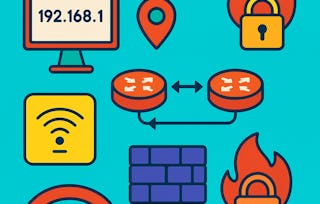
By completing this course, learners will gain a practical understanding of the essential protocols that power today’s computer networks. You’ll explore the significance of protocols such as ARP and Spanning Tree Protocol, learning how they work together to prevent Layer 2 loops and maintain network stability. The course provides clear explanations of critical services like DHCP and DNS, illustrating how dynamic IP assignment and domain name resolution are fundamental to seamless connectivity. You’ll also delve into NAT and PAT, discovering how these techniques enable secure and efficient internet access for multiple devices.

您将学到什么
Understand how protocols like ARP, STP, DHCP, DNS, NAT, and PAT ensure stable and secure network operation
Gain practical knowledge of HTTP, SMTP, Telnet, SSH, and RDP for designing and troubleshooting networks
您将获得的技能
要了解的详细信息

添加到您的领英档案
December 2025
6 项作业
了解顶级公司的员工如何掌握热门技能

积累特定领域的专业知识
- 向行业专家学习新概念
- 获得对主题或工具的基础理解
- 通过实践项目培养工作相关技能
- 获得可共享的职业证书

该课程共有6个模块
The MAC address is a unique identifier assigned to each network interface or network adapter, and it plays a vital role in device identification, data link layer communications, and address resolution. Address resolution is the process of resolving an IP address to a MAC address, and it is extensively used when a device wants to communicate with another device on the same local network. In this module, you will learn about the popular Layer 2 protocol, the Address Resolution Protocol (ARP), and its workings as well as the Spanning Tree Protocol (STP), what it is and how it removes loops from the network.
涵盖的内容
2个视频4篇阅读材料1个作业
A router is a networking device that operates in Layer 3 of the OSI model and connects two or more packet-switched networks together. It is responsible for forwarding packets by determining the optimal path for data to reach its destination. This process of selecting the best path for data packets is called routing. The router uses routing protocols and algorithms to find the optimal route for the packets. This topic describes routing and how routing protocols operate in Layer 3.
涵盖的内容
2个视频1篇阅读材料1个作业
DHCP and DNS are both important networking protocols that play significant roles in facilitating communication and connectivity within computer networks. In this module, you will learn about the popular application layer protocols, DHCP and DNS, and their roles in IP assignment and IP resolution, respectively.
涵盖的内容
1个视频1篇阅读材料1个作业
While protocols such as ARP, STP, and DHCP are widely known, protocols such as Hypertext Transfer Protocol (HTTP), File Transfer Protocol (FTP), Secure Shell (SSH), and other commonly known protocols are equally essential for keeping the data flowing in a network. In this module, you will explore these popular networking protocols and understand their role and significance in the networking world.
涵盖的内容
1篇阅读材料1个作业
In computer networks, address translation refers to the conversion of one type of network address into another. This translation helps devices on different networks communicate with each other by converting the source and destination addresses. In this module, you will learn about two of the most popular address translations: Network Address Translation and Port Address Translation.
涵盖的内容
1个视频1篇阅读材料1个作业
涵盖的内容
1篇阅读材料1个作业
获得职业证书
将此证书添加到您的 LinkedIn 个人资料、简历或履历中。在社交媒体和绩效考核中分享。
位教师

从 Networking 浏览更多内容

Cisco Learning and Certifications

Cisco Learning and Certifications

Cisco Learning and Certifications
人们为什么选择 Coursera 来帮助自己实现职业发展


常见问题
To access the course materials, assignments and to earn a Certificate, you will need to purchase the Certificate experience when you enroll in a course. You can try a Free Trial instead, or apply for Financial Aid. The course may offer 'Full Course, No Certificate' instead. This option lets you see all course materials, submit required assessments, and get a final grade. This also means that you will not be able to purchase a Certificate experience.
When you enroll in the course, you get access to all of the courses in the Specialization, and you earn a certificate when you complete the work. Your electronic Certificate will be added to your Accomplishments page - from there, you can print your Certificate or add it to your LinkedIn profile.
Yes. In select learning programs, you can apply for financial aid or a scholarship if you can’t afford the enrollment fee. If fin aid or scholarship is available for your learning program selection, you’ll find a link to apply on the description page.
更多问题
提供助学金,