Korea Advanced Institute of Science and Technology(KAIST)

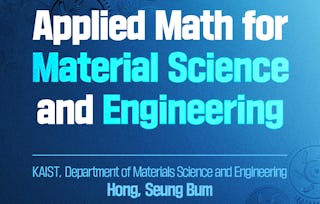
Applied Math for Materials Science and Engineering (Part 2)

通过 Coursera Plus 提高技能,仅需 239 美元/年(原价 399 美元)。立即节省
Korea Advanced Institute of Science and Technology(KAIST)

Applied Math for Materials Science and Engineering (Part 2)

Seungbum Hong

位教师:Seungbum Hong

包含在 Coursera Plus

深入了解一个主题并学习基础知识。
中级 等级

推荐体验

1 周 完成
在 10 小时 一周
灵活的计划
自行安排学习进度
深入了解一个主题并学习基础知识。
中级 等级

推荐体验

1 周 完成
在 10 小时 一周
灵活的计划
自行安排学习进度

您将学到什么

  • Apply multiple integration in Cartesian, cylindrical, and spherical coordinates to calculate physical properties like moments of inertia.

  • Determine series convergence using comparison, ratio, and integral tests, and represent functions as Taylor and power series.

  • Use complex numbers and Euler's formula to solve differential equations for engineering systems such as LCR circuits.

  • Transform area and volume elements between coordinate systems using the Jacobian and scale factors.

要了解的详细信息

可分享的证书

添加到您的领英档案

最近已更新!

April 2026

作业

7 项作业

授课语言:英语(English)

了解顶级公司的员工如何掌握热门技能

Petrobras, TATA, Danone, Capgemini, P&G 和 L'Oreal 的徽标

该课程共有4个模块

In this module, you'll learn how to perform multiple integration, starting with geometric volume calculations for spheres and cones, then expanding to more complex geometries. You'll work across three coordinate systems (Cartesian, cylindrical, and spherical) and discover why the Jacobian and scale factors are essential when transforming between them. By the end of the module, you'll apply these tools to calculate solid angles and moments of inertia, physical quantities that appear throughout materials science and engineering.

涵盖的内容

9个视频5篇阅读材料2个作业

This module focuses on the convergence criteria for infinite series, covering essential tools such as the comparison, ratio, and integral tests. You will delve into Taylor and power series to understand how functions are represented as polynomials within a specific radius of convergence. Next you will apply these techniques to approximate complex physical laws in relativistic mechanics and perform term-by-term calculus to solve advanced engineering problems.

涵盖的内容

14个视频5篇阅读材料2个作业

Complex numbers are far more than abstract math, they're a powerful tool for solving real engineering problems. This module introduces the definition and basic operations of complex numbers, transitioning from Cartesian form to polar representation. Using Euler’s formula, you will explore the profound relationship between complex exponentials and trigonometric functions. You will apply these mathematical tools to analyse LCR electrical circuits, learning to solve differential equations by reducing them to algebraic forms using impedance and phase analysis. This technique is one you will use repeatedly in electrical engineering and physics.

涵盖的内容

16个视频8篇阅读材料2个作业

This module provides a comprehensive evaluation of the core concepts of Applied Math for Materials Science and Engineering. You will demonstrate your ability to integrate across multiple coordinate systems, test series for convergence, apply Taylor approximations, and use complex number techniques to solve engineering problems. The final exam evaluates your proficiency in constructing mathematical models and analysing materials science and engineering systems through diverse coordinate systems and approximation methods.

涵盖的内容

1个作业

位教师

Seungbum Hong
Korea Advanced Institute of Science and Technology(KAIST)
7 门课程55,694 名学生

提供方

从 Electrical Engineering 浏览更多内容

人们为什么选择 Coursera 来帮助自己实现职业发展

Felipe M.

自 2018开始学习的学生
''能够按照自己的速度和节奏学习课程是一次很棒的经历。只要符合自己的时间表和心情,我就可以学习。'

Jennifer J.

自 2020开始学习的学生
''我直接将从课程中学到的概念和技能应用到一个令人兴奋的新工作项目中。'

Larry W.

自 2021开始学习的学生
''如果我的大学不提供我需要的主题课程,Coursera 便是最好的去处之一。'

Chaitanya A.

''学习不仅仅是在工作中做的更好:它远不止于此。Coursera 让我无限制地学习。'
Coursera Plus

通过 Coursera Plus 开启新生涯

无限制访问 10,000+ 世界一流的课程、实践项目和就业就绪证书课程 - 所有这些都包含在您的订阅中

通过在线学位推动您的职业生涯

获取世界一流大学的学位 - 100% 在线

加入超过 3400 家选择 Coursera for Business 的全球公司

提升员工的技能,使其在数字经济中脱颖而出

常见问题