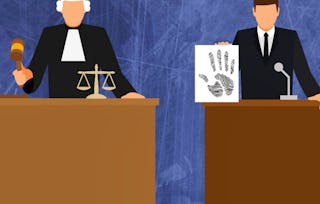
This course explains the scientific principles and techniques behind forensic science, moving beyond popular media portrayals. It uses case studies from around the world to illustrate real-world applications.
This course is for anyone interested in the scientific methods used in criminal and non-criminal investigations, including students considering careers in science, law enforcement, or related fields. No prior forensic science background is required, but a basic understanding of science is helpful.
By the end of this course, you will be able to:
- Understand the scientific foundations of forensic investigations.
- Identify and analyze various types of physical evidence.
- Explain the role of chemistry and biology in forensic analysis.
- Interpret forensic findings using real-world case examples.
Learners will gain familiarity with analytical techniques such as chromatography and spectroscopy, commonly used in forensic laboratories.
*For Nanyang Technological University (NTU) students, please be noted that this course will no longer be eligible for credit transfer.
This module examines the broad range of Forensic Science and situates the discipline within its legal framework. Foundational ideas such as Association and Reconstruction are reviewed, the crucial Locard Exchange Principle is explained in detail, and the potential limits of Forensic Science are considered. These core concepts provide the essential foundation for understanding any forensic investigation.
Week 1 - 10 The Woodchipper Murder Case; Summary•10分钟
4篇阅读材料•总计40分钟
Introduction to the Course•5分钟
Recommended Readings•10分钟
Code of Conduct•10分钟
Lecture Materials: Introduction to Forensic Science•15分钟
3个作业•总计40分钟
Final Quiz: Introduction to Forensic Science•20分钟
Knowledge Check 1.1•10分钟
Knowledge Check 1.2•10分钟
Chemical Analysis in Forensic Science
第 2 单元•小时 后完成
单元详情
This module covers the principles of chemical analysis in forensic science. You will learn the link between atomic structure and spectroscopic methods for elemental composition, understanding why these techniques are reliable. You will then apply these principles to molecular compounds, learning essential methods like Chromatography, Infra-red Spectroscopy, and Mass Spectrometry. Focus on understanding the practical application of each method, as these techniques are essential for analyzing narcotics and conducting toxicological investigations.
涵盖的内容
11个视频1篇阅读材料
显示有关单元内容的信息
11个视频•总计105分钟
Week 2A - 1 Introduction to Atomic Structure•17分钟
Week 2A - 2 Structure of the Atom•15分钟
Week 2A - 3 Elemental Analysis•3分钟
Week 2A - 4 Analysis of Microscopic Objects•4分钟
Week 2A - 5 Napoleon Case•9分钟
Week 2A - 6 JFK Assassination Case•5分钟
Week 2A - 7 "Adam" Case; Summary•8分钟
Week 2B - 1 Introduction to Chromatography•15分钟
Week 2B - 2 GC & HPLC•11分钟
Week 2B - 3 Infrared Spectroscopy•8分钟
Week 2B - 4 Mass Spectrometry; Summary•10分钟
1篇阅读材料•总计10分钟
Lecture Materials: Chemical Analysis in Forensic Science•10分钟
Time of Death and Blood Evidence
第 3 单元•小时 后完成
单元详情
In this module, you will investigate two critical areas of forensic analysis. First, you will examine the post-mortem changes the body and its remains undergo over time scales ranging from minutes to centuries, which are essential for determining the time of death. The focus will then shift to the analysis of blood evidence. You will learn established, non-DNA methods for identifying and individualizing blood, and discover the crucial information that can be deduced from blood spatter patterns to help reconstruct the events of a crime.
涵盖的内容
11个视频1篇阅读材料1个作业
显示有关单元内容的信息
11个视频•总计92分钟
Week 3A - 1 Recent Deaths•11分钟
Week 3A - 2 Decomposing Bodies I (Putrefaction)•6分钟
Week 3A - 3 Decomposing Bodies II (Forensic Entomology)•12分钟
Week 3A - 4 Analysis of Skeletal Remains I•8分钟
Week 3A - 5 Analysis of Skeletal Remains II•12分钟
Week 3A - 6 Ötzi Case; Summary•4分钟
Week 3B - 1 Blood•13分钟
Week 3B - 2 Tests for Blood•7分钟
Week 3B - 3 Precipitin Technology•4分钟
Week 3B - 4 Blood Spatter Analysis•8分钟
Week 3B - 5 Lord Lucan Case; Summary•7分钟
1篇阅读材料•总计15分钟
Lecture Materials: Time of Death; Blood•15分钟
1个作业•总计30分钟
Week 3 (MCQ Set 1)•30分钟
DNA in Forensics
第 4 单元•小时 后完成
单元详情
In this module, you will explore the pivotal role of DNA, an essential and ubiquitous tool in modern forensic science. You will gain a comprehensive understanding of the fundamental nature of DNA and how its analysis is employed in a variety of contexts. Through a series of key topics, you will investigate the landmark first criminal case solved with DNA, its application in resolving cold cases, its use in paternity and maternity testing, and the distinct characteristics of mitochondrial DNA, among other critical subjects.
In this comprehensive module, you will investigate the forensic analysis of three distinct categories of physical evidence. You will begin with fingerprinting, exploring its history, composition, methods of visualization, and classification systems, while also addressing the potential for forgery. The focus will then shift to polymers and fibres, where you will apply your knowledge from the spectroscopy and chromatography sections to learn how natural and synthetic fibres—including the particularly important evidence of hair—can be distinguished and individualized. Finally, you will examine firearms, covering their history and mechanics before concentrating on crucial forensic topics such as the analysis of gunshot residue (GSR) and ballistic striations.
涵盖的内容
11个视频1篇阅读材料1个作业
显示有关单元内容的信息
11个视频•总计97分钟
Week 5A - 1 History of Fingerprinting•12分钟
Week 5A - 2 Principles of Fingerprinting•10分钟
Week 5A - 3 Visualising Fingerprints•4分钟
Week 5A - 4 Brandon Mayfield Case; Summary•4分钟
Week 5B - 1 Introduction to Polymers & Fibres•18分钟
In this module, you will conduct a comprehensive examination of narcotics, beginning with their classification into natural, semi-synthetic, and synthetic types. You will investigate the use and effects of a range of prominent illegal drugs, including cannabis, cocaine, opium, heroin, morphine, LSD, amphetamines, and ketamine. The curriculum delves into the methods for their detection and identification, explaining how analyzing impurities can be a key technique for identifying the synthetic route used in a drug's creation. To provide a complete and current perspective, you will also explore the challenges posed by analogs and designer drugs and review the strategic measures used to control the illegal drug market.
涵盖的内容
6个视频1篇阅读材料1次同伴评审
显示有关单元内容的信息
6个视频•总计74分钟
Week 6 - 1 Types of Illegal Drugs•10分钟
Week 6 - 2 Cocaine•16分钟
Week 6 - 3 Opium, Morphine & Heroin•15分钟
Week 6 - 4 Synthetic Drugs•18分钟
Week 6 - 5 Analogs•9分钟
Week 6 - 6 Detection and Identification of Drugs; Summary•6分钟
1篇阅读材料•总计10分钟
Lecture Materials: Narcotics•10分钟
1次同伴评审•总计120分钟
Ruritania Case Study, "The Sturgkh Assassination"•120分钟
Toxicology
第 7 单元•小时 后完成
单元详情
In this module, you will conduct a comprehensive investigation into the field of toxicology, examining different types of poisons and their effects on the human body. You will analyze their modes of action and routes of administration, and you will learn to apply the concept of LD50 as a critical measure of toxicity. Your study will be grounded in foundational principles, such as Paracelsus's concept of the poison, and will cover specific substances like arsenic, alcohol, and nerve agents in detail. To solidify your understanding, you will apply these concepts by analyzing various case studies that illustrate the complex circumstances of accidental, deliberate, and occupational poisoning.
涵盖的内容
12个视频1篇阅读材料1个作业
显示有关单元内容的信息
12个视频•总计130分钟
Week 7 - 1 Introduction to Toxicology•17分钟
Week 7 - 2 Deliberate & Accidental Poisoning•10分钟
Week 7 - 3 Toxins & Biological Poisons•8分钟
Week 7 - 4 LD50•12分钟
Week 7 - 5 Forensic Toxicology•14分钟
Week 7 - 6 Alcohol•20分钟
Week 7 - 7 Inorganic Poisons - Arsenic•15分钟
Week 7 - 8 Inorganic Poisons - Thallium•5分钟
Week 7 - 9 Inorganic Poisons - Barium•5分钟
Week 7 - 10 Nerve Agents•13分钟
Week 7 - 11 Georgi Markov Case•4分钟
Week 7 - 12 Alexander Litvinenko Case; Summary•6分钟
1篇阅读材料•总计10分钟
Lecture Materials: Toxicology•10分钟
1个作业•总计30分钟
Week 7 (MCQ Set 3)•30分钟
Forensic Science Case Studies
第 8 单元•小时 后完成
单元详情
In this capstone module, you will synthesize the knowledge and skills acquired throughout the course by analyzing a curated collection of real-world case studies. These cases serve a dual purpose: they will not only reinforce the key forensic concepts and techniques you have learned, but also introduce new and important topics. You will deconstruct the investigative processes and pivotal evidence in a diverse range of landmark cases, including the historical identification of King Richard III, the complex investigations of JonBenét Ramsey and the Unabomber, and the classic forensic work in the Dr. Crippen case, among others, to highlight the critical aspects of forensic science in practice.
涵盖的内容
7个视频2篇阅读材料
显示有关单元内容的信息
7个视频•总计63分钟
Week 8 - 1 King Richard III Case•11分钟
Week 8 - 2 Annie Le Case•7分钟
Week 8 - 3 June Devaney Case•4分钟
Week 8 - 4 JonBenét Ramsey Case•15分钟
Week 8 - 5 The Unabomber Case; Psychological Profiling•9分钟
Young and research-intensive, Nanyang Technological University (NTU Singapore) is ranked 13th globally. It is also placed 1st amongst the world’s best young universities. NTU has about 33,000 students in the colleges of engineering, science, business, education, humanities, arts, social sciences. Its medical school is set up jointly with Imperial College London. A melting pot of international award-winning scientists, young talents and eminent global partners, NTU is also home to several world-class research institutes that builds on its strengths in interdisciplinary research.
Its a great course, i have learnt alot about forensic science and i am thinking of pursuing this career. Mr.Roderick Bates is a great Instructor and i wish i can do my Diploma and Degree with him.
R
RG
5·
已于 May 23, 2025审阅
This course is helpful most specially to those who are becoming forensic Investigators and Future law enforcer and of course this is a pre-law subject . Thanks to those who propose this
R
RM
5·
已于 May 13, 2021审阅
Beautiful... The Lecture and the cases were awesome. Dr.Rodreick Bates was so clear and a lot of hardwork has gone into this course preparation. It was an absolutely interesting course.
Forensic science applies scientific principles and methods to legal questions, often in criminal and civil cases. This course introduces the core concepts and techniques used by forensic scientists.
What skills will I gain from this forensic course?
You will gain skills in criminal investigation, evidence analysis, laboratory testing, and understanding forensic chemistry and biology. This includes interpreting DNA evidence and applying scientific methods.
Does this course cover DNA analysis and molecular biology?
Yes, the course includes a dedicated module on DNA in forensics, covering its fundamental nature, analysis methods, and applications in criminal cases and paternity testing, drawing on molecular biology principles.
Will I learn about chemical testing methods?
Yes, a significant portion of the course focuses on chemical analysis in forensic science. You will learn about spectroscopic and chromatographic methods for identifying substances, crucial for toxicology and narcotics testing.
Is prior science knowledge required for this course?
No prior forensic knowledge is required. A basic understanding of general science concepts will be helpful, but the course is designed to introduce scientific principles as they apply to forensic investigations.
When will I have access to the lectures and assignments?
To access the course materials, assignments and to earn a Certificate, you will need to purchase the Certificate experience when you enroll in a course. You can try a Free Trial instead, or apply for Financial Aid. The course may offer 'Full Course, No Certificate' instead. This option lets you see all course materials, submit required assessments, and get a final grade. This also means that you will not be able to purchase a Certificate experience.
What will I get if I purchase the Certificate?
When you purchase a Certificate you get access to all course materials, including graded assignments. Upon completing the course, your electronic Certificate will be added to your Accomplishments page - from there, you can print your Certificate or add it to your LinkedIn profile.
Is financial aid available?
Yes. In select learning programs, you can apply for financial aid or a scholarship if you can’t afford the enrollment fee. If fin aid or scholarship is available for your learning program selection, you’ll find a link to apply on the description page.