KB
4.0评论日期:Aug 11, 2024
Enzyme kinetic reactions can also be included in the course

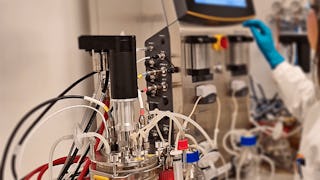
Bioprocesses make use of microorganisms, animal cells, or enzymes to manufacture new products or complete a chemical transformation. Since ancient days, humans have been using microorganisms to transform biological materials for the production of alcoholic beverages and other fermented foods. Since then, bioprocesses have been developed for an enormous range of commercial products, from relatively cheap products such as organic solvents and industrial alcohol, to expensive specialty chemicals such as therapeutic proteins, antibiotics, and vaccines. Nowadays, the development of bioprocesses is an essential part of a large number of chemical, food, and pharmaceutical industries. The main purpose of the course “Introduction to Industrial Bioprocess Development” is to provide an overview of the common stages involved in this type of processes. The course is primarily aimed at students, researchers, and professionals with an interest in bioprocessing, biomanufacturing, or fermentation technology. Some knowledge of biology, biotechnology and/or biochemical engineering will be advantageous, but not mandatory. The course begins with a brief description of some basic properties of microorganisms and general aspects related to their use in bioprocesses at industrial scale. Following this, the kinetic bases for cell growth, substrate utilization and product formation during batch, continuous and fed-batch cultures are discussed. In addition, the course includes a group of lectures dedicated to some stages that precede fermentation; specifically, media formulation, sterilization, preservation of microorganisms and inoculum preparation. The main characteristics of predominant types of industrial bioreactors along with process parameters that need to be controlled in stirred tank reactors are also covered in one of the modules of the course. Since the expansion of a bioprocess from a lab scale to an industrial scale is of considerable importance, an additional lecture dedicated to this topic is presented. The last part of the course provides a general overview of downstream processing, addressing processes used for the removal of cells from the culture medium, methods for the disruption of cells, and isolation of the target bioproduct. By the end of the course, you should: # Be able to identify the fundamental difference between the two basic cell types: eukaryotic and prokaryotic cells # Distinguish the main steps of the brewing process # Identify some important steps in recombinant protein production # Define the different stages of the industrial production of bioethanol # Distinguish the main characteristics of the three fermentation modes: batch, continuous and fed-batch # Define important parameters of the continuous fermentation mode # Identify bioprocesses where fed-batch fermenters are used and for how long can a fed-batch process be run # Identify how defined and undefined fermentation media are formulated # Discuss the role that key components of culture media play in bioconversion processes # Recognize the importance in avoiding microbial contamination # Describe chemical and physical sterilization methods # Distinguish the main characteristics of common techniques of cell preservation # Recognize factors that are commonly considered to obtain an inoculum suitable for fermentation at industrial scale # Define what a bioreactor is and in which industrial bioprocesses are commonly used # Identify the main parameters that need to be controlled during microbial conversions in STRs # List relevant parameters that are considered for scale-up purposes # Define the sequential steps of downstream processing # Distinguish different methods for biomass removal or cell harvesting # Select common unit operations used for primary isolation
KB
Enzyme kinetic reactions can also be included in the course
AP
It was a good course. Made us aware on various biotechnological processes in industrial scale.
OS
aAn amazing beginners' guideguide!I totally recommend
MB
Videos very well explained. Appreciate the transcripts for videos and note taking feature.
MS
informative for beginners seeking for knowledge about biprocess in industry
ME
Es war sehr gut und nützlich, um alles, was wichtig und Grundlage ist, zu wiederholen
MS
A very insightful course for chemical engineering and a lot of visuals for understanding.
SN
The topics of the course was very interesting and brush up the memory for Bioprocess Eng.
MP
Subjects were explained in a easy and undestandable way. It would be great to have a more detailed course, howerver, for an introduction course it was great.
SG
I found this course very useful for my educational and professional career.
DM
Good to learn this area of work for industrial applications
AS
Great kick-off training to join the Bioprocess Industry
显示:20/70
I do not recommend this course. The pronunciation is unacceptable and the testing is not aligned with the lectures.
It was a quite a depth course, though it's mentioned for beginners. I, myself is a biotechnology student, and working in a biopharma industry where I have exposure to almost all these things. Overall quite a good course.
Useful but boring
very good course provides the fundamentals of industrial biotechnology processes in food and bio-pharmaceutical as well as biofuel fields powered with fluent explanations and illustrated videos.
A very insightful course for chemical engineering and a lot of visuals for understanding.
Videos very well explained. Appreciate the transcripts for videos and note taking feature.
I would like it to be more detailed and let you apply much more of the calculations and knowlege. A good method to achieve this would be build in more examples of practise problems for both calculations and structural design of bioprocesses. However, I still liked the course very much even though I finished like 26 days sooner than expected.
Content-rich course, with useful diagrams, flowcharts and information. Thorough explanations and technical terms used. I enjoyed it and learned a lot. However, overall english pronunciation is not very good.
El curso fue excelente de principio a fin. El contenido estaba bien estructurado y era fácil de seguir. El/la instructor/a fue muy conocedor/a y supo explicar conceptos complejos de manera sencilla. Me gustó mucho la combinación de teoría y práctica, ya que me permitió aplicar lo aprendido de inmediato. Además, el ambiente de aprendizaje colaborativo fue muy enriquecedor. Recomiendo este curso a cualquiera que quiera aprender de manera efectiva y agradable. ¡Gracias por una experiencia tan positiva!
The course is well presented by the researchers and the information present is all well organised. This MOOC introduces fermentation, bioreactor and it processes in stepwise manner. It is pretty easy to follow and understand. Suitable for beginner and researcher from closely related field (eg. Molecular biologist) to explore.
very informative and well structured, yet I felt the need of the course to go more in depth explaining specific realtime operations describing the measures taken for optimizing the process and prevent contamination. Also mentioning the bioengineered organisms and their optimization and selection criteria.
Un curso fácil para entender lo básico sobre los bioprocesos en general. Hay uno que otro cálculo que debe realizarse y es genial. Los videos son concretos y no divagan mucho en los temas, lo que se agradece bastante. Las lecturas sugeridas de cada módulo son excelentes. Totalmente recomendado.
This course was engaging and very useful for my career path. I studied biotechnology so I had seen these concepts in class, but reviewing them with an application perspective truly sparked my interest and strengthened my understanding. Highly recommend!
Detailed explanation and high focusing on real application! But, it would be better if the lectures in week 5 deal with more technologies such as various chromatography methods in depth.
This course was very informational and a great introductory into bioprocess devleopment. The instructors were amazing and taught the subjects with great detail. Thank you!
Subjects were explained in a easy and undestandable way. It would be great to have a more detailed course, howerver, for an introduction course it was great.
Excelente curso, es de gran importancia para estudiantes de ingeniería bioquímica y muy bien impartido por los ponentes
The topics of the course was very interesting and brush up the memory for Bioprocess Eng.
Course was great and thank you so much for making informative videos for us .
informative for beginners seeking for knowledge about biprocess in industry