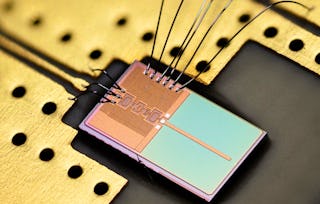
Modern RF systems—spanning wireless communications, radar, satellites, and emerging 5G/6G technologies—demand precise circuit design and validation. As frequencies rise, traditional circuit intuition becomes unreliable, making advanced simulation essential for predicting real-world behavior before hardware is built.
This course equips learners with practical, industry-ready skills in RF and microwave design using Keysight ADS. Through guided demos and hands-on labs, you will master S-parameter analysis, transmission-line modeling, impedance matching, and electromagnetic (EM) simulation with Momentum. Real engineering scenarios show how coupling, parasitics, and layout effects influence performance, and how ADS enables accurate prediction and optimization.
By the end of the course, you will confidently design RF schematics, evaluate matching networks, analyze antennas and filters, and refine layouts through EM-based validation. Whether you are building wireless front-end modules, optimizing radar components, or modeling high-frequency behavior for next-generation systems, this course provides the applied expertise needed to produce manufacturable, professional-grade RF designs.
Master the fundamentals of high-frequency circuit simulation using Keysight ADS, the industry-standard RF simulation tool. Students will learn to navigate the ADS interface, set up RF circuit simulations, understand S-parameters and frequency domain analysis, and interpret simulation results. This foundational module establishes the skills needed to simulate and validate RF circuit performance before physical prototyping, enabling efficient design iteration and optimization.
涵盖的内容
4个视频2篇阅读材料1次同伴评审
显示有关单元内容的信息
4个视频•总计33分钟
Course Introduction•3分钟
Setting Up Your First ADS Project and RF Schematic•6分钟
Running S-Parameter Simulations and Reading Results in ADS•8分钟
Time-Domain and AC Analysis for RF Circuits in ADS•16分钟
2篇阅读材料•总计10分钟
Welcome to the Course: Course Overview•5分钟
A/RF Circuit Analysis: Simulation Across Frequency Spectrums•5分钟
1次同伴评审•总计20分钟
Hands-On-Learning: Designing a Simple Matching Network in ADS•20分钟
Transmission Line Analysis and Impedance Matching
第 2 单元•小时 后完成
单元详情
Master transmission line simulation and impedance matching using Keysight ADS. Students will learn transmission line fundamentals, understand impedance concepts and the Smith chart, and design impedance matching networks. This module emphasizes how proper impedance matching ensures signal integrity, maximizes power transfer, and enables optimal RF system performance in wireless communications, radar, and satellite applications.
涵盖的内容
3个视频1篇阅读材料1次同伴评审
显示有关单元内容的信息
3个视频•总计25分钟
Simulating Transmission Lines with Different Impedances in ADS•5分钟
Advanced Impedance Matching Techniques for Broadband Circuits•5分钟
Smith Chart and Filter Design Applications in ADS•15分钟
1篇阅读材料•总计5分钟
Transmission Line Analysis: Cable Health Case Study•5分钟
1次同伴评审•总计20分钟
Hands-On-Learning: Building and Analyzing a Bandpass Filter Circuit•20分钟
Electromagnetic Simulation and Component Behavior
第 3 单元•小时 后完成
单元详情
Master electromagnetic simulation using Keysight ADS to evaluate component behavior and RF system performance. Students will learn when and why to use EM simulation, understand how to set up 3D electromagnetic simulations, and interpret EM simulation results. This module emphasizes how EM simulation reveals coupling effects, radiation patterns, and component interactions that circuit-level simulation cannot capture, enabling accurate prediction of real-world RF system performance.
涵盖的内容
4个视频1篇阅读材料1个作业2次同伴评审
显示有关单元内容的信息
4个视频•总计24分钟
Introduction to Electromagnetic Simulation with Momentum•6分钟
Simulating Antennas and Antenna Arrays with EM Tools•7分钟
Advanced EM Analysis: Coupling and Cross-Talk in Complex Circuits•8分钟
Course Wrap-Up•3分钟
1篇阅读材料•总计5分钟
Why RF Engineers Need EM Simulation for Designing RF Circuits•5分钟
Coursera brings together a diverse network of subject matter experts who have demonstrated their expertise through professional industry experience or strong academic backgrounds. These instructors design and teach courses that make practical, career-relevant skills accessible to learners worldwide.
What does simulation-driven RF design in ADS mean in this course?
It means using ADS to predict how RF and microwave circuits will behave before hardware is built, rather than relying on circuit intuition alone. The course focuses on analyzing circuit response, matching, transmission-line behavior, and layout-driven effects as part of a practical design process.
When would you use this simulation-driven approach?
You would use it when a high-frequency design needs to be checked before fabrication, especially when impedance, bandwidth, loss, or layout effects can change performance. In this course, that includes validating matching behavior, transmission-line behavior, and whether a schematic still looks realistic once physical effects are considered.
How does simulation-driven RF design fit into a broader workflow?
It sits between the first circuit idea and the final physical implementation, helping you turn a schematic into something you can test and refine with confidence. The course treats it as a repeatable loop of building a design, simulating it, interpreting the results, and updating the circuit or layout.
How is simulation-driven RF design in ADS different from trial-and-error prototyping?
Instead of finding problems only after hardware is built, simulation-driven design checks matching, gain, transmission-line behavior, and layout effects earlier in the process. In this course, the emphasis is on using simulation to guide design decisions first, then moving into electromagnetic validation when circuit-level results are not enough.
Do you need any prerequisites before learning simulation-driven RF design in ADS?
A basic understanding of circuits and common electronic components is helpful before starting. Prior RF experience can make the material easier, but the course is designed to build practical simulation skills step by step.
What tools, platforms, or methods are used in this course?
The course centers on Keysight ADS, including ADS Momentum for electromagnetic simulation. Learners mainly work with S-parameter analysis and impedance-matching methods using transmission lines and Smith charts.
What specific tasks will you practice or complete in this course?
You practice setting up RF schematics, running DC, AC, and S-parameter simulations, modeling transmission lines, and designing matching networks. You also interpret Smith charts and simulation plots, then refine layouts with electromagnetic validation to check coupling, parasitics, and other high-frequency effects.