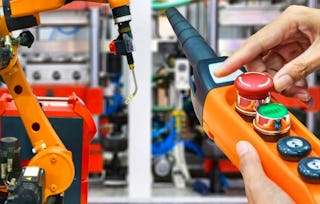
In an era where automation and intelligent robotics redefine high-tech manufacturing, mastering robotic programming and integration is key to achieving precision, scalability, and efficiency. This course equips engineers and manufacturing professionals with the technical foundations to design, program, and deploy industrial and mobile robotic systems in modern production environments. Through interactive modules and hands-on labs, learners explore the evolution of industrial robotics, key robot types and applications, and the principles of motion control, task sequencing, and sensor integration using classical programming methods such as RAPID, KRL, and Python APIs and robotics programming framework like ROS 2. Participants also examine collaborative and autonomous systems, end-of-arm tooling, and vision-based precision, culminating in advanced integration exercises that introduce ROS 2 as a framework for interoperability.
Learners should be familiar with basic understanding of manufacturing processes, basic knowledge of industrial robotic systems, basic computer science concepts and introductory programming experience.
This course is designed for engineers and technical professionals looking to build practical skills in robotics programming and smart manufacturing integration.
By course completion, learners will be able to program, configure, and coordinate robotic systems that meet the demands of Industry 4.0.
This module introduces learners to the various types of robotics used in high-tech manufacturing. It covers the evolution of industrial automation, applications of different robot types, and the benefits and limitations of implementing advanced robotics systems. An introduction to the robotics and advanced robotics is also included.
涵盖的内容
4个视频2篇阅读材料1次同伴评审
显示有关单元内容的信息
4个视频•总计35分钟
Introduction to Robotics in High-Tech Manufacturing•4分钟
Introduction to Robotics in High-Tech Manufacturing•11分钟
Types of Industrial Robots and Their Applications•10分钟
Precision and Sensing: End-of-Arm Tooling (EOAT) and Vision Systems•9分钟
2篇阅读材料•总计10分钟
Welcome to the Course: Course Overview•5分钟
Robot Guidance Using Machine Vision Techniques in Industrial Environments: A Comparative Review•5分钟
1次同伴评审•总计20分钟
Hands-On-Learning: Robotics System Selection for High-Tech Manufacturing Automation•20分钟
Collaborative & Autonomous Robotics
第 2 单元•小时 后完成
单元详情
This module focuses on collaborative robots (cobots) and autonomous mobile robots (AMRs), examining operational principles, benefits, challenges, and real-world applications. Learners will explore how cobots safely interact with human operators and how AMRs enable flexible material transport across dynamic production environments. The module also covers strategies for selecting, deploying, and integrating these systems to optimize productivity, safety, and efficiency in modern manufacturing.
涵盖的内容
3个视频1篇阅读材料1次同伴评审
显示有关单元内容的信息
3个视频•总计34分钟
Collaborative Robots: Design Principles and Industrial Objectives•12分钟
Autonomous Mobile Robots: Capabilities, Scope, and Operational Goals•11分钟
The Integration Challenge: Fleet Management and Digital Twin•11分钟
1篇阅读材料•总计5分钟
Mobile Robots and Cobots Integration: A Preliminary Design of a Mechatronic Interface by Using MBSE Approach•5分钟
1次同伴评审•总计20分钟
Hands-On-Learning: Designing Collaborative and Autonomous Robot Deployment for an EV Assembly Line•20分钟
Programming, System Integration, and Real-World Implementations
第 3 单元•小时 后完成
单元详情
This module provides a technical deep dive into robot programming and system integration for high-tech manufacturing. Learners will explore programming tools like RoboDK, control and communication strategies, and the integration of both industrial robots and autonomous mobile robots (AMRs) in production environments.
涵盖的内容
6个视频1篇阅读材料1个作业2次同伴评审
显示有关单元内容的信息
6个视频•总计59分钟
Basics of Robot Programming - Part 1•13分钟
Basics of Robot Programming - Part 2•14分钟
Advanced Robot Programming•11分钟
Advanced Robotics Integration with ROS 2 and Industry Systems - Part 1•12分钟
Advanced Robotics Integration with ROS 2 and Industry Systems - Part 2•6分钟
Course wrap-up•3分钟
1篇阅读材料•总计5分钟
Integrated Fleet Management of Mobile Robots for Enhancing Industrial Efficiency: A Case Study on Interoperability in Multi-Brand Environments Within the Automotive Sector •5分钟
1个作业•总计20分钟
Robotics in High-Tech Manufacturing•20分钟
2次同伴评审•总计80分钟
Hands-On-Learning: Designing Efficient Workflows for Industrial Robots and AMRs•20分钟
Project: Create a Factory of the Future – NeoFab One Digital Twin•60分钟
Coursera brings together a diverse network of subject matter experts who have demonstrated their expertise through professional industry experience or strong academic backgrounds. These instructors design and teach courses that make practical, career-relevant skills accessible to learners worldwide.
When will I have access to the lectures and assignments?
To access the course materials, assignments and to earn a Certificate, you will need to purchase the Certificate experience when you enroll in a course. You can try a Free Trial instead, or apply for Financial Aid. The course may offer 'Full Course, No Certificate' instead. This option lets you see all course materials, submit required assessments, and get a final grade. This also means that you will not be able to purchase a Certificate experience.
What will I get if I purchase the Certificate?
When you purchase a Certificate you get access to all course materials, including graded assignments. Upon completing the course, your electronic Certificate will be added to your Accomplishments page - from there, you can print your Certificate or add it to your LinkedIn profile.
Is financial aid available?
Yes. In select learning programs, you can apply for financial aid or a scholarship if you can’t afford the enrollment fee. If fin aid or scholarship is available for your learning program selection, you’ll find a link to apply on the description page.