SP
4.0评论日期:Sep 30, 2018
This course helped me a lot in determining bacterial typing. Just one question, in some quizzes I got some answers wrong so is there any way of knowing the right answer.
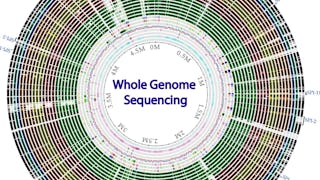
This course will cover the topic of Whole genome sequencing (WGS) of bacterial genomes which is becoming more and more relevant for the medical sector. WGS technology and applications are high on international political agenda, as the classical methods are being replaced by WGS technology and therefore bioinformatic tools are extremely important for allowing the people working in this sector to be able to analyze the data and obtain results that can be interpreted and used for different purposes. The course will give the learners a basis to understand and be acquainted with WGS applications in surveillance of bacteria including species identification, typing and characterization of antimicrobial resistance and virulence traits as well as plasmid characterization. It will also give the opportunity to learners to learn about online tools and what they can be used for through demonstrations on how to use some of these tools and exercises to be solved by learners with use of freely available WGS analysis tools . By the end of this course you should be able to: 1. Describe the general Principles in typing of Bacteria 2. Give examples of the applications of Whole Genome Sequencing to Surveillance of bacterial pathogens and antimicrobial resistance 3. Apply genomic tools for sub-typing and surveillance 4. Define the concept of Next-Generation Sequencing and describe the sequencing data from NGS 5. Describe how to do de novo assembly from raw reads to contigs 6. Enumerate the methods behind the tools for species identification, MLST typing and resistance gene detection 7. Apply the tools for species identification, MLST typing and resistance gene detection in real cases of other bacterial and pathogen genomes. 8. Describe the methods behind the tools for Salmonella and E.coli typing, plasmid replicon detection and plasmid typing 9. Utilize the tools for Salmonella and E.coli typing, plasmid replicon detection and plasmid typing in real cases of other bacterial and pathogen genomes. 10. Explain the concept and be able to use the integrated bacterial analysis pipeline for batch analysis and typing of genomic data 11. Demonstrate how to construct phylogenetic tree based on SNPs 12. Apply the phylogenetic tool to construct phylogenetic trees and explain the relatedness of bacterial or pathogen strains 13. Describe how to create your own sequence database 14. Utilize the MyDbFinder tool to detect genetic markers of interest from whole genome sequencing
SP
This course helped me a lot in determining bacterial typing. Just one question, in some quizzes I got some answers wrong so is there any way of knowing the right answer.
AR
Excellent course for students who don't know much about sequencing and its analysis. It's very easy and very understandable for students new to bioinformatics.
AA
Excellent Course. Many thanks to DTU and Coursera for providing such a wonderful course. I learned a lot of things from this course. This course is definitely a winner.
AM
This is an interesting course. I do not have any prior knowledge of bioinformatics but I was able to understand with constant practice. Thank you DTU! Thank you, Coursera!!!
TN
The course provides some basic ideas about sequencing and assembling in a fairly easy to understand manner. However, the parts of phylogenic trees are badly explained.
CS
Thank you very much coursera and all educators who helped me learn this WGS. This course is just awesome. It really helps me pursue my career. Once again thanks alot to DTU TEAM.
MO
The course is very educative, and I enjoyed the presentations. However, I found that I could not use most of the tools. It seems the web-based versions have been discontinued.
MA
This course was very informative and videos were very engaging. As a soil microbiologist this course provides you an introduction to tools which are being used in epidemiology.
KK
One of the best bioinformatics courses. We get to learn and get hands-on practice on free online bioinformatics tools. Well explanatory lectures to guide us on using bioinformatic tools.
UC
Please correct the text as there are many mistakes. It it simply not being typed correctly to what the teachers are actually saying. Otherwise I think it was a good course. I enjoyed it. Thanks :)
RN
Very Good Course!!! All the tutors were awesome and easy to understand. Overall the course met my needs. I am very happy and satisfied!!. Thank You coursera!!!
AP
Thank you very much for this course through which i learnt basic handling of bioinformatics tools and concepts of WGS. This will help me a lot while pursuing my PhD research work in my field.
显示:20/424
This course is mostly just an advertisement for the particular tools created by the CGE. It would have benefited from deeper explanations of the algorithms at many points. It didn't really build skills, though I am certainly more aware of the breadth of their online tools now.
It is basically a commercial for their tools. Not much content to learn.
If you are willing to learn about the WGS analysis, this is not the course for you. The course is all about tools developed by DTU and how to use them. There is a very insufficient background given for all tools. A lot of time has been spent on explaining unnecessary details about using tools, like where to put email it! Concepts are not explained properly. I find the course structure very poor. Last but not least, the main instructor of the course has an accent very difficult to comprehend.
I quite liked the instructors, but after the first few lessons, the course essentially becomes an advertisement/user manual for their university's (admittedly free) online software tools.
One of the best bioinformatics courses. We get to learn and get hands-on practice on free online bioinformatics tools. Well explanatory lectures to guide us on using bioinformatic tools.
It is totally beneficial course for those who are working in epidemiology, however; I was expected to learn different tools for species and microbial communities identification.
great course but unavailability of their online tools makes the course almost impossible to complete ! they call it a beginner's course but there are many parameters in the tools that you need to set on your own and there is no instruction given in the sample files !
Please make videos on how to handle those tools from scratch with a demo sample ! Showing screenshots one after another is not helpful for beginners :)
A well structured course covering a broad range of topics, and being a part of this course was an amazing learning experience..
Thanks to DTU and Coursera family....
A course which is worthy for a researcher who is involved in whole genome analysis and pathogen identification. The course gives a base to the use of cge website.
Videos are not comprehensive enough even if one already has some knowledge of that area!
Excellent course for the beginners with minimum bioinformatics knowledge to analyse their whole genome sequencing data!!! All the course materials are designed adequately with in-depth discussion and hands-on training on the usage of different tools. It would be helpful to update the course materials based on the current development of the tools. Otherwise, highly recommended tools for gaining the most out of WGS data. Thanks.
Thank you very much for this course through which i learnt basic handling of bioinformatics tools and concepts of WGS. This will help me a lot while pursuing my PhD research work in my field.
Excellent course with a wealth of information about tools and applications of whole genome sequencing. Presented in a very lucid and interesting manner, very crispy and simplified course.
The course is using cutting-edge genome sequencing technology and the authentic software to showcasing the applications and tools of genome sequencing. It is a great chance to learn it.
Thank you great team from DTU, I get to understand NGS via your detailed explanation and useful demonstration as well as example exercise. Cheers
I am a biology student, who recently started a masters in bioinformatics and have been struggling to try to keep up with the computational aspects and this course was perfect for me. The pacing of the course was really good and the lectures were also well detailed and to the point. I really liked the passion with which Shinny did her lecture segments.
Despite the promising title, the course is mainly a collection of video tutorials on DTU's Center for Genomic Epidemiology web tools. The tools are limited to only epidemiological and pathogem surveillance application, may not be what you're looking for. The tools for NG sequencing of genomes and its interpretation are not covered at all. Wouldn't recomment to anyone not involved in genomiс epidemiology.
I am an undergraduate student and have worked with bacteria and have also conducted antimicrobial assays for bacteria (like MIC). Apart from wet-lab, I also wanted to have dry-lab experience in this field. "Whole-genome sequencing of bacterial genomes - tools and applications" by DTU really helped me a lot in understanding the basics of this field and has also introduced me to their user-friendly web-based bioinformatic tools developed and hosted by Centre of Genomic Epidemiology. The course instructors were also very clear in explaining the working of these tools.
First of all I would like to thank coursera and DTU for providing such a good platform where one can learn and get trained in the subjects of ones interest from the leading experts. The course was very informative and I should say that I have learned something new which I was not familiar with, and would surely look forward for more such trainings by DTU team in future. The way of teaching by the DTU team was very nice especially by Dr Pimlapas.
Madam/Sir,
I am a Computer Science Engineer, I am doing research in University of Calcutta in Machine Learning. I have some interest in Bioinformatics. It is not possible for me to grab all the aspect in that subject. So, I am grabbing it in scattered way. The course I have completed in "DTU" has captured a complete different aspect which I haven't seen before. The most important things is that it is a very neat and clean course with a specific direction. All the labs which I have performed here has been well taught in various videos. Though it is not possible for me to understand every parts of all the videos but still it gives me enough knowledge to complete the practicals. I hope it will help me in future run.
I would like to specify just one problem related with the course. Every course in Coursera has "Discussion Forum" corresponding to every week, which I have found missing, as it solves lot of dynamic problem in each week's tutorial. I am sorry if "Discussion Forum" is already there and I have ignored that.
Thanks You very much,
Gourab Das