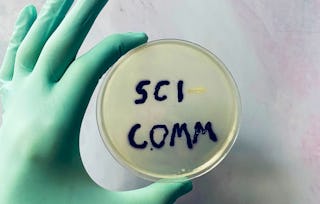
Whether you are a member of the natural or human science community, if you are a PhD student, professor, part of an academic department or international research team, or self-employed and you wish to showcase your work to a wider audience then this is the perfect course for you. You will learn how to promote your work to professional peers, the general public, as well as the media.
The free version (open to all enrollments) contains:
30 videos (4 and a half total hours) of high-quality lessons conducted by various experts.
Multiple embedded discussions, readings, and reflective tasks (4-5 hours) to further deepen your learning.
Several discussion forums where you can network and collaborate with fellow participants.
Participants who wish to obtain official Coursera certification for their training are invited to carry out and receive passing grades on three peer-reviewed assignments and two quizzes.
In this MOOC, we have been incredibly fortunate to gather a team of experienced professionals from scientific experts, to media specialists, to communication coaches, who frequently appear at conferences and on various face-to-face and online platforms. You will gain key takeaways that you can adapt to your own communication contexts. To further deepen your learning experience, you will collaborate with an international scientific community to reflect on and fine-tune your own skills in pitches, presentations, approach to question and answer sessions, networking, and speaking to the media.
Authors' note: While the course is intended for self-study use, it has also been successfully piloted in flipped classroom English as a Medium of Instruction (EMI) training contexts.
Watch the Teaser here! https://www.youtube.com/watch?v=_FxZTUg_Ntk
In this first introductory module, we will help you get acquainted with each other and the course objectives. We will also offer tips on how to get the most out of this course. These tasks are to be combined with the work you do in Week 1.
涵盖的内容
1个视频2篇阅读材料2个讨论话题1个插件
显示有关单元内容的信息
1个视频•总计2分钟
Welcome! An introduction from your course leader, Bethany Cagnol•2分钟
2篇阅读材料•总计4分钟
How to get the most out of this course•1分钟
Instructions for using the "Notes" feature•3分钟
2个讨论话题•总计15分钟
Introduce yourself•5分钟
What do you hope to gain from this course? •10分钟
1个插件•总计1分钟
Where are you from? •1分钟
Structure your Ideas with Cécile Michaut
第 2 单元•小时 后完成
单元详情
Welcome to the first week of this course entitled "Structure your Ideas." Cécile Michaut will be your communication coach for this week. Here is what you will be doing with Cécile: Identifying your No. 1 objective for promoting your research and your main message; adapting your message to a variety of audiences and contexts; knowing when and how to limit jargon; putting everything together in a short and concise pitch of your work.
涵盖的内容
7个视频1篇阅读材料1次同伴评审5个讨论话题
显示有关单元内容的信息
7个视频•总计40分钟
Introduction to this module•3分钟
What is your goal?•5分钟
What is your message?•5分钟
Who is your audience?•7分钟
Which platform for which audience?•7分钟
Leave the jargon behind•8分钟
Your pitch•5分钟
1篇阅读材料•总计10分钟
Specialized terminology reduces the number of citations of scientific papers•10分钟
1次同伴评审•总计180分钟
Your Research Pitch (in writing)•180分钟
5个讨论话题•总计45分钟
Why do you want to promote your research?•10分钟
What is your main message?•10分钟
Who is your audience?•10分钟
Match the medium with the audience•10分钟
Explaining jargon •5分钟
Enhance your Scientific Presentations with Bethany Cagnol
第 3 单元•小时 后完成
单元详情
Welcome to Week 2 of the course entitled "Enhance your Scientific Presentations. Bethany Cagnol will be your coach for this week. One of the key features of this module is it can be adapted to presentations you give in front of your peers, but also the general public. In this module, you'll cover some presentation basics just to get you off on the right foot. Then, we'll cover some key language points that you should keep in mind. Next, Bethany will give you her top tips for online presentations as well as panel discussions. And finally, we'll end the module with a Case Study in which you'll study a 45mn video from the NASA's "Maniac" series given by the international climate expert and University of Georgia professor, Dr. J. Marshall Shepard, who gave us permission to use this video as an example of good scientific presentation skills. Finally, be sure to check out the Resources section of this course for some valuable take aways to use for your next scientific presentations. In the forum, let us know if those help you, or if you'd like us to add other resources.
涵盖的内容
6个视频1篇阅读材料1个作业1个讨论话题1个插件
显示有关单元内容的信息
6个视频•总计31分钟
Introduction to this module•3分钟
Back to the Basics•8分钟
Language Points for Presentations •7分钟
Online Presentations•7分钟
Panel Discussions•3分钟
Bethany's introduction of the Case Study on Dr. J. Marshall Shepherd•3分钟
1篇阅读材料•总计10分钟
Week 3 Case Study Instructions•10分钟
1个作业•总计10分钟
Enhance your Scientific Presentations•10分钟
1个讨论话题•总计20分钟
Observations from Dr. Marshall Shepherd's "Maniac" Lecture•20分钟
1个插件•总计45分钟
Dr. J. Marshall Shepherd: Zombies, Sports, and Cola: Implications for Communicating Weather and Climate•45分钟
Answering challenging questions with Sinead Namur
第 4 单元•小时 后完成
单元详情
In this module, we will be addressing Question and Answer sessions (a.k.a. Q & A sessions). You will have plenty of opportunities to self-reflect and study good and not-so-good examples in this highly unique, interactive module designed by your coach for this week, Sinead Namur. She will guide you through two hypothetical Q in A scenarii in which a professor, Dr. Johnson, is confronted with very tough questions from audience members. In these two scenarii, you will have the opportunity to reflect on what works and what doesn't. And at the end of the module, you will be given some key no fail advice and phrases that you can use, if and when you are faced with a tough Q&A session. TOP TIP: This could be quite an intensive week for you as almost every video has integrated self-reflective prompts. You can use the Note section to store your thoughts, but we suggest you keep a back up of all your notes on a separate document on your computer or notebook just in case. That way they are easy to find right when you need them.
涵盖的内容
6个视频1次同伴评审
显示有关单元内容的信息
6个视频•总计31分钟
Introduction to Week 3•4分钟
Reflecting on tough audience questions•5分钟
Reflecting on appropriate responses•6分钟
Debrief on inappropriate responses•5分钟
Observing appropriate responses•6分钟
Debrief on appropriate responses•5分钟
1次同伴评审•总计180分钟
Peer-reviewed Task for Week 3: Mp3 Q&A•180分钟
Networking with various experts with Bethany Cagnol
第 5 单元•小时 后完成
单元详情
In this module, your coach, Bethany, covers the importance of networking in the sciences with both our peers and outside our professional contexts. A collection of experts agreed to offer their input and share their experience with you. First, Mary Ann Horn, a Mathematics professor at Case Western Reserve University and a Former NSF Program Director in Applied Mathematics, will offer advice on the importance of cross-disciplinary networking as well as how networking ties into applying for grants. Next, we'll hear from Armelle Rancillac, a research fellow in neurobiology at the prestigious Collège de France and INSERM. She will speak about networking at public outreach events and on social media. Then, we'll hear from Mahasti Saghatchian, a medical oncologist and Vice President of the medical board at the American Hospital of Paris. She will stress the importance and benefits of networking on social media for the medial industry and patients. And finally, the president of Télécom Paris, Nicolas Glady, will offer his advice on networking in Academic and Corporate Contexts and what researchers should keep in mind when reaching out to business angels.
涵盖的内容
6个视频1个作业1个讨论话题
显示有关单元内容的信息
6个视频•总计62分钟
Introduction to Week 4: Networking•2分钟
Spotlight on a mathematician: Collaborating in other fields and applying for grants•15分钟
Spotlight on a neuroscientist: Reaching out to the general public•18分钟
Spotlight on an oncologist: Getting the most out of social media•14分钟
Spotlight on the President of Télécom Paris: Networking in academic and corporate contexts•8分钟
Top Tips for Networking in the Sciences•5分钟
1个作业•总计10分钟
Quiz for Week 4: Networking in the sciences•10分钟
1个讨论话题•总计10分钟
Self-reflective task: What networking channels do you use? •10分钟
Interacting with the Press with various experts
第 6 单元•小时 后完成
单元详情
In this course's final module, Cecile Michaut is back as your coach and she's gathered an all-star team of experts to help you communicate with the media. First, you'll hear from Frédéric Restagno, a CNRS professor of physics, on his first-hand experience on what it's like to work on television. Then, Cécile will offer key tips to get you started on your journey with the written press and web publications. Next, journalist Catherine de Coppet will offer learners no-fail advice for interviewing on the radio and how you can set the foundation for getting invited back again and again. Then, Audrey Mikaëlian will cover the realities of television appearances whether they be for pre-recorded or live interviews. Cécile will then sum up the module with essential advice on building a sustainable relationship with the media. And be sure to check out Bethany's "Last Word" of the course on what you can do with your newly developed skills.
涵盖的内容
6个视频1次同伴评审1个讨论话题
显示有关单元内容的信息
6个视频•总计42分钟
Frédéric Restagno, CNRS research professor of physics•8分钟
The written press and the web•7分钟
Catherine de Coppet on Interviewing for Radio•10分钟
Audrey Mikaëlian on Interviewing for Television•8分钟
Building a sustainable relationship with the media•6分钟
Last word from your course leader, Bethany Cagnol•4分钟
1次同伴评审•总计180分钟
Final Assessed Task: Your Video Pitch •180分钟
1个讨论话题•总计20分钟
Analyzing interviews: What types of questions should you expect?•20分钟
Institut Mines-Télécom is a public institution dedicated to higher education, research and innovation in engineering and digital technologies.
Always attentive to the economic world, IMT combines strong academic legitimacy, close corporate relations. It focuses on key transformations in Digital Technologies, Production, Energy and Ecology and trains the engineers, managers and PhDs who will be tomorrow’s players in these key changes of the 21st century.
Its activities are conducted in Mines and Télécom graduate schools under the aegis of the Minister for Industry and Electronic Communication, one subsidiary school and three strategic partners. The IMT’s schools rank among the leading graduate schools in France.
When will I have access to the lectures and assignments?
To access the course materials, assignments and to earn a Certificate, you will need to purchase the Certificate experience when you enroll in a course. You can try a Free Trial instead, or apply for Financial Aid. The course may offer 'Full Course, No Certificate' instead. This option lets you see all course materials, submit required assessments, and get a final grade. This also means that you will not be able to purchase a Certificate experience.
What will I get if I purchase the Certificate?
When you purchase a Certificate you get access to all course materials, including graded assignments. Upon completing the course, your electronic Certificate will be added to your Accomplishments page - from there, you can print your Certificate or add it to your LinkedIn profile.
Is financial aid available?
Yes. In select learning programs, you can apply for financial aid or a scholarship if you can’t afford the enrollment fee. If fin aid or scholarship is available for your learning program selection, you’ll find a link to apply on the description page.