AU
5.0评论日期:Mar 16, 2021
This course is very effective for practical process control and instrumentation

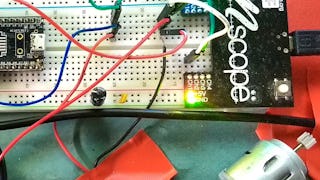
"Sensor Manufacturing and Process Control" can also be taken for academic credit as ECEA 5343, part of CU Boulder’s Master of Science in Electrical Engineering degree. This is our fourth course in our specialization on Embedding Sensor and Motors. To get the most out of this course, you should first take our first course entitled "Sensors and Sensor Circuits", our second course entitled "Motor and Motor Control Circuits", and our third course entitled "Pressure, Force, Motion, and Humidity Sensors". Our first course gives you a tutorial on how to use the hardware and software development kit we have chosen for the lab exercises. Our second and third courses give you three hands-on lab experiments using the kit. This third course assumes that you already know how to use the kit. You will learn about sensor signal characterization and manufacturing techniques and how to optimize the accuracy of sensors. You will also learn about more advanced sensors, proportional-integral-derivative (PID) control, and how this method is used to give you a closed loop sensor feedback system. After taking this course, you will be able to: ● Understand how sensor manufacturers characterize and calibrate their sensors. ● Tune a PID control loop and access the PID control function of the Cypress PSoC development kit for a motor control application. ● Understand manufacturing methods used to build electro-mechanical and micro-machined sensors. This course includes specific hardware and software requirements. Please review the FAQ below for complete details.
AU
This course is very effective for practical process control and instrumentation
DS
good information i learnt from the sensor manufacturing and process control thank you coursera to be a part of my course
NK
it was great course to gain knowledge of the sensor and pid implementation techniques..thank you for teaching us
EM
i find it to be life changing course, it is ery interestingThanks
AM
I enjoy every bit of learning this course !!! It improved my pre-existing knowledge and given a practical approach to learning using PSoC projects
KC
have got a lot idea about industrial sensors and protocols and their construction theory
DR
Great course, well done. Lots of good information here
KS
excellent ,we need more practice while solving the problem. material is very useful to answer the questions
GP
This video session is very useful to learn both theoretical and practical
AN
Very informative course. Highly reccomended for Electrical Engineering students.
GQ
This program is exceptional and really practical. Challenging computations in Process Control and Instrumentation .Awesome
PR
Full course is very useful for me and for my job also.
显示:20/80
I have learned a lot with this sensor specialization. Some selected application notes part from the reading material are very worth the time spent. The view is broad, sensor circuits, MEMS manufacturing techniques, etc. It helps me progress, better understand what I have seen in my career so far in the aerospace, electrical and medical industries.
This video session is very useful to learn both theoretical and practical
good one
Good👍
Great course, great content and learning material. It has real lab exercises with careful instructions. You can still do the assignment without real circuit, but learning by doing will be more efficient, and of course this subject needs real equipment.
The quiz is really helpful for each module lesson, but some of them are a bit difficult or having typing problem. Teachers should acknowledge and correct that. I hope lecture videos can have more animations about how devices work.
Excellent Class and i learned more from here
It's very useful
please increase the contents...Descriptions in presentation slides are not enough well to get clear understanding though we went through the referred text books and links
It was good.
some concepts in the first 2 weeks were not quite well explained
Instruction was not clear.
Sensor Manufacturing and Process Control focuses on the design, development, and optimization of sensors to meet modern industrial and technological demands. This field merges engineering, materials science, and automation to produce sensors with high precision, reliability, and efficiency. Key aspects include: 1. Sensor Manufacturing Material Selection: Materials like semiconductors, ceramics, and polymers are tailored to specific sensing applications (temperature, pressure, motion, etc.). Fabrication Techniques: MEMS (Micro-Electro-Mechanical Systems): Used for miniaturized sensors with intricate features. Additive Manufacturing (3D Printing): Enables customized geometries and rapid prototyping. Traditional Methods: Casting, molding, and lithography for bulk production. Integration: Incorporating sensors into larger systems like IoT devices or smart technologies. 2. Process Control in Manufacturing Quality Assurance: Ensuring sensors meet performance benchmarks through rigorous testing. Real-time Monitoring: Utilizing AI and data analytics for continuous feedback during production. Automation: Robotic systems for precision assembly and minimizing human error. Standardization: Following global standards (ISO, IEC) to ensure compatibility and reliability. Challenges and Innovations Challenges: Miniaturization without losing accuracy. Balancing cost-efficiency with high performance. Innovations: Development of self-calibrating sensors. Use of nanotechnology for enhanced sensitivity. Integration with AI for predictive maintenance and smarter systems. Conclusion Sensor manufacturing and process control are pivotal for advancing modern industries, from healthcare to aerospace. With continuous innovations, this field is set to redefine precision and efficiency in technology-driven applications.
I enjoy every bit of learning this course !!! It improved my pre-existing knowledge and given a practical approach to learning using PSoC projects
Great course to learn about
Sensor Manufacturing and Process Control in details.I highly recommend this course and thank you all.
This program is exceptional and really practical. Challenging computations in Process Control and Instrumentation .Awesome
good information i learnt from the sensor manufacturing and process control thank you coursera to be a part of my course
it was great course to gain knowledge of the sensor and pid implementation techniques..thank you for teaching us
excellent ,we need more practice while solving the problem. material is very useful to answer the questions
have got a lot idea about industrial sensors and protocols and their construction theory
Very informative course. Highly reccomended for Electrical Engineering students.